
Airbnb Pre-Check-In Messages: A Three-Message Cadence for Arrival Day
Send three Airbnb pre-check-in messages instead of one long note: a confirmation, a logistics message 24 to 72 hours out, and access details the evening before. See what to automate and what stays with the host.
Written and reviewed by Liam, Founder, Morphic
Guide fit
Self-managing Airbnb hosts who want arrival questions to stop landing late at night without adopting a full PMS
Three short messages beat one long one: a confirmation, a logistics note 24 to 72 hours out, and access details the evening before.
Decide what to schedule, draft, or reviewDirect answer
Send three pre-check-in messages, and keep the access code a host-supplied fact.
A pre-check-in message is any Airbnb message a booked guest receives before arrival. The cadence that works is three: a short confirmation right after booking, a logistics note 24 to 72 hours before check-in covering parking, directions, and an arrival-time question, and the exact address and entry details the evening before. Automation is good at timing and repetition. It is not a source of truth for the door code, the cleaning status, or an early check-in promise. Morphic drafts and schedules those messages from the connected Airbnb listing, booking, and calendar context, starting in Copilot so the host reviews what goes out. Morphic does not generate, rotate, or verify access codes and does not connect to locks, so a smart lock or keypad keeps its own job while the messaging layer owns timing.
Confirm
Immediately after booking
Thank the guest, confirm the dates, and point to the arrival guidance. Nothing that can go stale, and no codes.
Prepare
24 to 72 hours before arrival
Parking, rough directions, neighborhood notes, and one question: what time do you expect to arrive?
Deliver
The evening before arrival
Full address, the entry method, and any final detail. Short and functional, not friendly and long.
Leave
Anything that can still change
Early check-in, cleaning-dependent timing, refunds, and exceptions stay with the host until someone real confirms them.
One long message is the actual problem
Most arrival confusion is not caused by hosts who forget to write. It is caused by hosts who write everything at once, three days early, into a message the guest skims once and then cannot find again.
A single long note has a predictable failure mode. The parking detail is read and forgotten, the address is buried in paragraph four, and the door code sits in the same thread for days. By the time the guest is standing at the building, the only thing they remember is that there was a message.
Splitting the same information into three short, single-purpose messages fixes the part that actually breaks: attention. Each message has one job, one moment, and one thing the guest can act on.
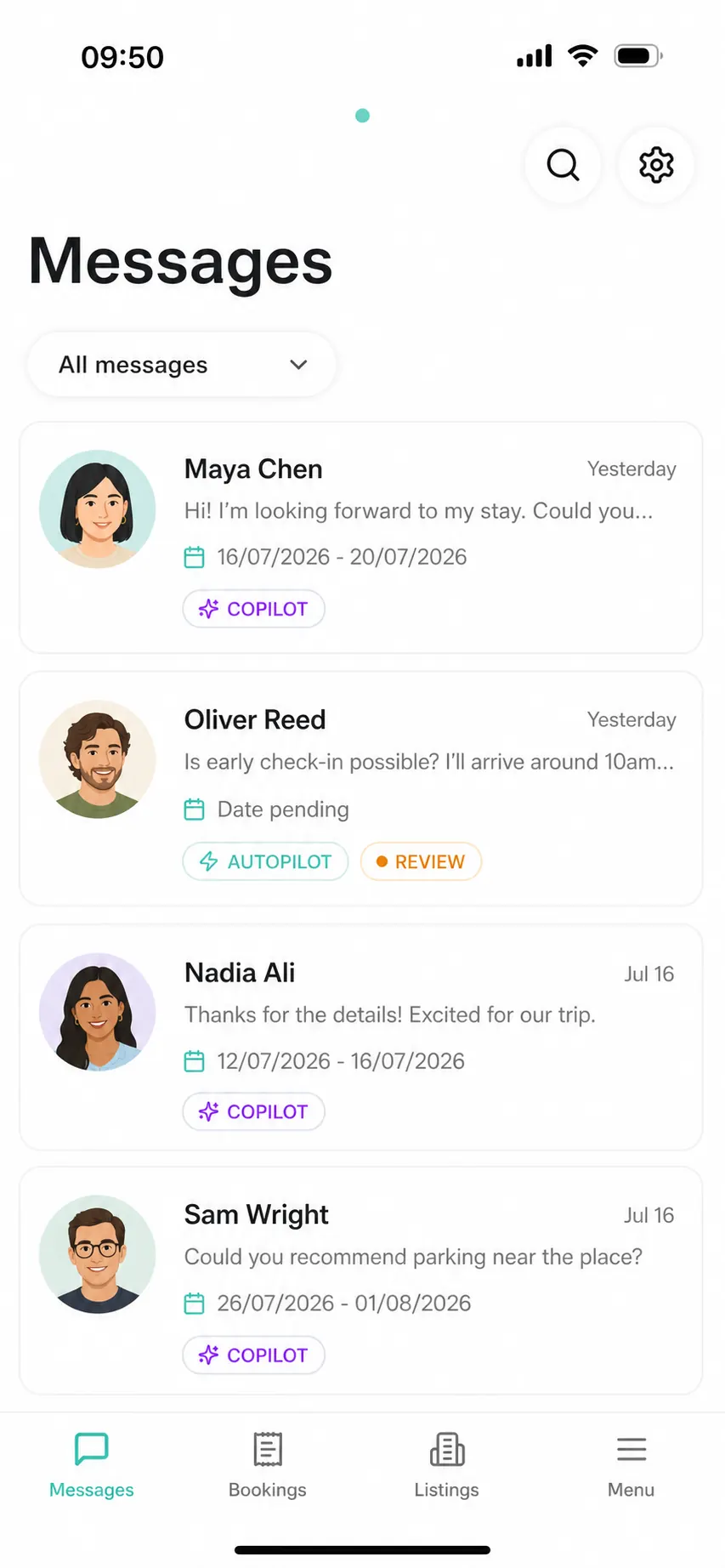
The three-message cadence, and what belongs in each
The timing does the work. Each message covers a different kind of information, and mixing them is what makes a guest scroll past the one field they needed.
| Message | When | What belongs in it | What must not |
|---|---|---|---|
| Confirmation | Immediately after booking | Dates, a thank-you, and a link to your arrival guidance | Parking, codes, or anything that changes before arrival |
| Logistics | 24 to 72 hours before check-in | Parking, rough directions, house notes, and an arrival-time question | The entry code, or a promise about early access |
| Access | The evening before arrival | Full address, entry method, and one fallback if arrival goes wrong | New information the guest has not seen before |
The arrival-time question in the logistics message is doing more work than it looks like it is. A guest who says 6 p.m. has given you something real to plan around, including whether the turnover has enough room, and a guest who never answers is a signal to check in again rather than assume.
What automation should own, and what it must not invent
The honest version of message automation is narrower than most software implies. It is very good at timing, repetition, and pulling the right context into a draft. It is not a source of truth about the physical property.
| Job | Automation can do this | It must not imply this |
|---|---|---|
| Timing | Send the logistics and access messages at the offsets you chose | That the host chose the offsets wisely for every stay |
| Context | Draft from listing, booking, calendar, and conversation context | That the draft is correct without being read |
| Repetition | Send the same stable facts to every guest | That a repeated fact is still true today |
| Access | Deliver the entry text the host supplied | That the tool generated, rotated, or verified the code |
| Exceptions | Surface a guest request for review | That early check-in, cleaning status, or a refund was decided |
Read the middle column as the product. The right-hand column is where messaging tools quietly overpromise: a scheduled send becomes "handled", a repeated template becomes "accurate", and a code in a message becomes "the guest is in".
Your smart lock keeps its job
If you already run a smart lock, a keypad, or Airbnb check-in instructions, keep running them. Morphic does not compete with the layer that creates and rotates a code, and it does not need to, because the two tools sit at different levels of the same arrival.
| Layer | Who owns it | What it does |
|---|---|---|
| Access hardware and code | Your lock app, keypad, or Airbnb check-in instructions | Creates, rotates, and expires the entry code |
| Stored arrival guidance | Your Airbnb listing | Holds the stable instructions Airbnb shows the guest |
| Timing and wording of the message | Morphic | Sends the entry text you supplied, at the offset you chose |
That split is what makes coexistence work. The lock keeps generating codes, the listing keeps storing the stable facts, and the messaging layer stops being a manual job. Nothing has to be ripped out for the cadence to run.
The one rule is that the code in the message has to come from somewhere real. If your lock rotates it per stay, paste the current code as a host-supplied fact before the access message goes, or send your lock app's own instructions and use the Airbnb thread for the address and the fallback. A messaging tool that invents a code it has no authority over is worse than a host sending it late.
Keep the whole cadence inside the Airbnb thread
Every message inside the platform is timestamped and tied to the reservation. That matters the moment a guest says they never received the address, because the record either exists in one place or it is spread across three apps you now have to reconcile.
Guests also get a push notification for an Airbnb message. An email with the door code can sit in a promotions folder until the guest is already at the door, and a code sent only by text is a code you cannot prove arrived.
If a guest genuinely prefers another channel, keep the option, mirror the important parts back into the thread, and never send the entry detail only off-platform.
Three templates you edit once
Write these once, keep each short, and let the assistant fill the guest name and dates from the booking.
1. Confirmation:
Hi [Guest name], thanks for booking [dates]. Your arrival guide is here: [link]. Message me any time with questions before your stay.
2. Logistics (24 to 72 hours out):
Hi [Guest name], a quick note before [day]. Parking is [detail]. The neighborhood has [one useful tip]. Roughly what time do you expect to arrive? It helps make sure everything is ready.
3. Access (evening before):
Hi [Guest name], here is everything for tomorrow. The address is [address]. Check-in opens at [time]. Entry is [method the host supplies]. If anything is unclear when you arrive, reply here and I will help straight away.
The access message is the one to keep plain. Guests want it fast and functional, and it is the last message that should carry a new fact they have to remember.
Measure the questions you stopped getting
Leading indicators are whether the cadence ran from the booking rather than a manual reminder, whether the arrival-time question got an answer, and whether the access message went out the evening before instead of days early.
The lagging signal that matters is simple: how many arrival-day questions you answered this month compared with last month. Do not report a scheduled send as proof of a better review outcome, a rating change, or revenue. A sent message is a sent message, and the guest experience is the only thing that can confirm the rest.
Frequently asked questions
What is a pre-check-in message on Airbnb?
It is any message a booked guest receives before arrival. In practice it works best as three: a confirmation right after booking, a logistics note 24 to 72 hours before check-in, and the address and entry details the evening before. It is different from a pre-booking message, which goes to someone who has not reserved yet.
When should I send Airbnb pre-check-in messages?
Send the confirmation immediately, the logistics message 24 to 72 hours before check-in, and the access message the evening before arrival. Airbnb documents scheduled quick replies and its own check-in instruction timing, so treat native Airbnb timing as the base layer and put the contextual, guest-specific parts on top of it.
Can Morphic send my pre-check-in messages automatically?
Morphic can draft and schedule pre-check-in messages from the connected Airbnb listing, booking, and calendar context. New work starts in Copilot, so drafts wait for host review, and the host can move routines they trust to Autopilot. Morphic does not generate, rotate, or verify access codes and does not connect to locks, so the entry detail itself stays a host-supplied fact.
I already use a smart lock or Airbnb check-in instructions. Do I replace them?
No, and you should not have to. Your lock app or keypad keeps creating and rotating the entry code, and Airbnb check-in instructions keep holding the stable arrival guidance on your listing. Morphic sits alongside both: it drafts and schedules the message that carries the code you supplied, at the offset you chose. It does not generate, rotate, or verify access codes, does not connect to locks, and does not replace the system that owns them.
Should I send the access code early if a guest asks?
Only if you are comfortable with the trade-off. A code sitting in a thread for days is a code that can be forwarded or screenshotted, and the usual reason hosts hold it until the evening before is exactly that. If a guest is arriving very late or from a different time zone, send it in their arrival window rather than days early.
How much does Morphic cost for guest messaging?
Morphic is priced at $9.90 per connected listing per month after a 21-day no-card trial that covers every listing. There is no separate PMS or external AI subscription required.
Appendix
Optional setup detail and source material for readers who want the evidence behind the guide.
Summary, setup notes, and next stepsSupporting details for readers and answer engines.
Key takeaways
Pre-arrival message cadence guide
This guide owns the timing of Airbnb pre-check-in messages and the boundary between scheduled timing and host-supplied facts. The setup guide owns message templates, AI reply configuration, and review rules; the arrival-resilience guide owns late arrivals and failed entry; and the automated-messages page remains the commercial owner for choosing what to schedule.
Open Decide what to schedule, draft, or reviewSetup sequence
Set up a three-message pre-check-in cadence on one listing
This sequence keeps the Airbnb thread as the record and leaves access, cleaning, and timing promises with the host.
- Step 1Connect the Airbnb listingImport listing, booking, calendar, and conversation context so the cadence works from real reservation timing instead of a reminder you copied into a phone alarm.
- Step 2Write the three messages onceDraft the confirmation, the logistics note, and the access message. Keep each one single-purpose; a message that covers five topics gets skimmed and forgotten.
- Step 3Separate stable facts from changing onesAddress, parking, and house rules are stable and safe to repeat. The entry code, cleaning readiness, and early check-in are not, and should be reviewed before they are sent.
- Step 4Start in CopilotLet the assistant draft from the booking context and wait for host approval. A wrong access detail sent automatically is worse than a late one sent correctly.
- Step 5Schedule the timing, not the promisesSet the logistics message 24 to 72 hours out and the access message the evening before. The host supplies the code text; the tool owns when the message goes.
- Step 6Watch one arrival cycleCount the questions you still get. Move only the routines that behaved correctly to Autopilot, and keep access and exception messages under review.
Where to go next
References behind this guideAirbnb and market references behind the claims in this guide.
Read next
Related guides on Airbnb automation, guest replies, tool comparison, and host control.
Automated messages
Airbnb Message Templates and Setup for Hands-On Hosts
A step-by-step guide for hands-on hosts using Airbnb scheduled messages, check-in and checkout templates, AI replies, drafts, and host review rules.
Arrival system
Airbnb Check-In Instructions: Build a Fail-Safe Arrival System
Build Airbnb check-in instructions guests can use when plans change: a clear arrival guide, a short reminder, a safe fallback, and a realistic late-arrival plan.
Guest communication
Airbnb Pre-Booking Message Examples for Hosts
Airbnb pre-booking message examples for hosts, with practical templates for common guest questions before they book.
Guest communication
Airbnb Guest Communication Guide for Hosts
Learn when to use Airbnb scheduled messages, a guest guidebook or QR code, and AI replies across the stay while keeping guest context in Airbnb and sensitive decisions under host control.