
Airbnb House Rules Policy (2026): Checkout Tasks, Fines & Host Checklist
Review Airbnb’s November 2026 house rules policy: booking dates, reasonable checkout requests, local fines, contracts and a practical update checklist.
Written and reviewed by Liam, Founder, Morphic
Guide fit
Airbnb hosts and small teams updating rules, guest guides and scheduled reminders
Policy checked October 21, 2026
Update the rule first. Then update every place that repeats it.
Airbnb’s new house rules policy applies to reservations booked on or after November 20, 2026. Hosts should review their listing’s House rules and requests, remove unreasonable demands, and reconcile guest guides and scheduled messages with the applicable saved rules. Keep checkout requests light, disclose genuine external requirements in the right place, and ask Airbnb about unclear exceptions rather than treating an unflagged edit as approval.
Date
Use the booking date
Separate the policy threshold from the date you edited your listing.
Task
Do not delegate the turnover
Distinguish a light departure request from work for the cleaner.
Record
Keep one consistent version
Review the listing, manual and pending messages together.
Which reservations does the new policy cover?
There are two clocks. Record both before changing a guest-facing promise.
The updated reasonable requests policy covers reservations booked on or after November 20, 2026. A December arrival booked earlier is not automatically in that cohort. Check the actual reservation rather than using arrival date as a shortcut.
Separately, Airbnb says changes to saved house rules and requests affect reservations received after the edit, not existing pending or confirmed reservations. Keep a dated copy of the prior version so you can identify what was disclosed for an existing booking. Source: rules editing and version handling.
| Example | Decision to make |
|---|---|
| Booked November 19, arriving in December | Check the previous policy and the rules saved for that booking |
| Booked November 20 or later | Review against the updated policy |
| Listing edited after a reservation was received | Do not assume the edit rewrites that reservation’s terms |
The interface began changing with Airbnb’s October 20 announcement. That is a reason to audit now, not evidence that November 20 is irrelevant. An existing booking is not permission to impose unreasonable or otherwise prohibited demands under other applicable policies.
Put each requirement in the right place
| Category | Its job | Boundary |
|---|---|---|
| Standard house rules | Set the available platform rule choices | Use the designated listing section; do not invent extra rules in a message |
| Requests | Explain reasonable expectations during a stay or before checkout | Timing does not exempt the request from the policy |
| Local rules | Disclose genuine HOA or local-government requirements and associated fines | A host preference cannot be relabeled as an external rule |
| Contracts | Disclose an agreement only in a permitted circumstance | A contract cannot override Airbnb policy |
Use Listings → select listing → Listing editor → House rules and requests. Under Requests → Add requests, choose the relevant timing and review the text before saving. Airbnb documents visibility before booking and in confirmed guests’ trip details. Current setup and disclosure.
A manual or sign can explain how to follow an already disclosed request; do not use it to add a surprise obligation. For a practical manual structure, use the guidebook template. Keep access codes and private contacts out of public materials.
Rewrite checkout requests without moving the cleaning job
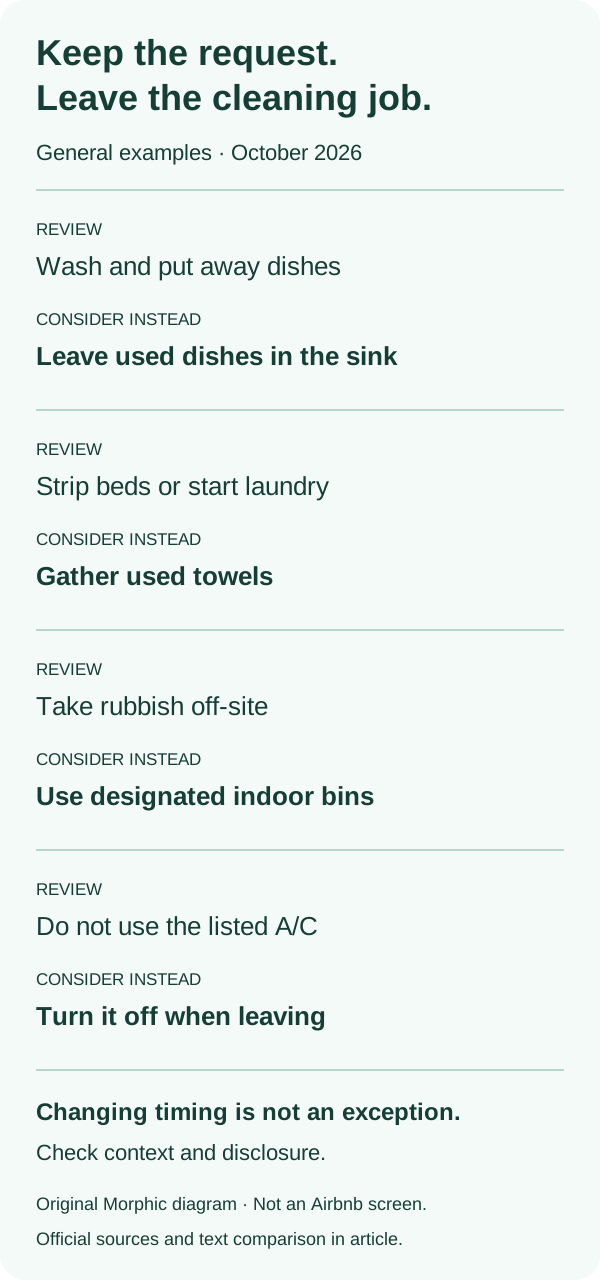
The useful change is less work for the guest—not the same demand in a different timing field.
| Review this demand | Lighter request to consider |
|---|---|
| Wash and put away dishes | Leave used dishes in the sink |
| Strip beds or start the laundry | Gather used towels |
| Carry rubbish off-site | Use designated indoor rubbish and recycling bins |
| Do not use the listed air conditioning | Turn it off when leaving |
These are general examples in Airbnb’s announcement, not a universal approval list. Keep only the reasonable, disclosed steps relevant to the property. Use the existing checkout templates for the departure message rather than copying this whole policy guide to guests.
For shared kitchens, do not assume that changing “wash before checkout” to “wash after every use” makes the requirement permissible. Listing type, stay and local circumstances can matter, but an exception needs a supported explanation, not a timing-field workaround. Describe the actual situation to Airbnb when uncertain. Reasonableness and exceptions.
Handle flagged text as a review, not a loophole
Airbnb’s editor may highlight text and explain the concern. Its Help page says unresolved flagged requests saved by a host can receive further review, with Airbnb contacting the host about next steps and relevant details. Correct clear problems; do not deliberately leave them unresolved as an appeal strategy. Editor review process.
The announcement also describes an opportunity to submit an appeal. Follow the instructions actually provided to your account. Prepare the original request, the explanation shown, listing and stay context, and any relevant local documentation. This is a preparation checklist, not a claim that a particular form or appeal sequence exists for everyone. A successful save or absence of highlighting is not formal policy approval.
Separate local fines from guest cleaning charges
A genuine HOA or local-government fine is not the same as a host-created penalty. Airbnb provides Requests → Add details for local rules. Explain the authority, the conduct covered, the amount or calculation and when it may be charged. If you receive a fine caused by a guest’s violation, keep the notice and evidence and use the documented reimbursement process; Airbnb does not collect or enforce those fines. Local rules and reimbursement.
Do not convert “unwashed dishes: $50” into an HOA rule unless a real external rule actually establishes that obligation and fine. Disclosure is not a guarantee that a charge is legally recoverable or that Airbnb will approve it.
Airbnb’s guest ground rules distinguish standard between-reservation cleaning from excessive or unexpected cleaning. Moldy dishes are an example of a possible excessive-cleaning condition; that does not make every sink of used dishes chargeable. Record the actual condition and costs, and use the applicable dispute process. Do not impose a checkout-task noncompliance fee. Guest cleanliness and fee boundaries.
Review contracts and personal information separately
The updated contract policy lists limited permitted circumstances: legal or community-association requirements, certain optional amenities, monthly stays of 28 nights or more, and Luxe stays. Even a permitted contract must comply with Airbnb’s policies; disclose its terms in the designated place. Airbnb does not require guests to sign or help enforce the agreement. Updated contract policy.
Do not use a monthly-stay agreement to reintroduce a prohibited cleaning demand. Identity checks and personal-data collection have their own restrictions and exceptions in the same policy; they are not an extension of the local-fines field. Check the exact requirement before collecting anything, minimize sensitive data, and obtain appropriate local advice where needed.
Run one rule audit across your listing and messages
Use one host-owned register rather than rewriting each surface independently.
| Record for each instruction | What to verify |
|---|---|
| Current wording and location | Listing rule, request, manual, sign or scheduled message |
| Purpose and authority | Security, light request, genuine external rule or permitted contract |
| Relevant bookings | Booking date and version disclosed at reservation |
| Decision | Keep, simplify, remove, or ask Airbnb about an exception |
| Responsible person | Who edits it and who handles the physical work instead |
| Follow-through | Saved version, affected reminders, guest questions and next review date |
First review the saved listing. Next reconcile your private manual and signs. Finally inspect upcoming scheduled messages for the affected bookings: remove contradictory chores and make the reminder match the applicable instructions. Do not send new terms merely because you changed a template. The native automated-message guide covers schedule setup and duplicates.
Native tools and a human review are usually enough for a small, stable rule set. A PMS may fit a broader multi-channel operation; a local cleaner handles turnover work. An assistant can help with repeated questions and follow-up, but software does not decide Airbnb exceptions or perform cleaning. Compare the scope in Airbnb automated messages, and keep the cleaner handoff separate.
Measure the cost before changing your cleaning fee
Do not assume extra cleaner minutes, laundry timing and rework are the same problem.
For your next ten turnovers, record the property type, occupied nights, guest tasks removed, cleaner minutes and cost, laundry availability, rework and whether the next-arrival deadline was met. Use actual quotes or invoices. This is an original measurement exercise—not evidence that most hosts have a laundry bottleneck.
| Observed constraint | Test before changing the price |
|---|---|
| More paid cleaning time | Confirm the changed work scope and actual cost with the cleaner |
| Linen unavailable when needed | Compare spare sets, laundry timing and available services |
| Repeated missed tasks | Clarify the cleaner’s checklist and verification |
| Not enough evidence | Continue recording comparable turnovers instead of assuming a fee increase is necessary |
Review your applicable fee settings and guest-facing total before making a pricing decision. This guide does not estimate your profit loss or promise that a higher fee will preserve conversion. Do not bill guests a penalty for skipping specific checkout chores.
Keep the policy guide current
Check the linked official pages again when Airbnb contacts you, changes the editor, or clarifies an exception. Retain the dated rule version and the reason for each change. After the first affected bookings, review guest questions, inconsistent reminders and cleaner handoffs; correct the specific mismatch rather than adding another long message.
This is independent educational guidance checked October 21, 2026, not legal advice or Airbnb approval. Examples and the diagram are original editorial material, not customer evidence. Third-party Facebook screenshots were not republished; no permission or authenticity is implied. Do not publish guest messages, identity documents, access details or fine notices as a case study without an appropriate privacy and permission review.
Frequently asked questions
Can Airbnb hosts ask guests to clean?
Reasonable, disclosed requests and turnover cleaning are different. The updated policy generally rules out significant cleaner-like tasks; consult its actual examples and context-dependent exceptions rather than treating every cleaning request as allowed or every light request as banned.
Can I move a cleaning request to During the stay?
A timing field is not an exemption. A shared-space situation may need context-specific review, but moving the same demand does not establish compliance.
Does the new policy apply to every arrival after November 20?
No. The updated policy identifies reservations booked on or after November 20, 2026. The booking date and the version of rules disclosed for that reservation matter.
Can I charge a fine when guests do not wash dishes?
Do not impose a fee for failing a checkout chore. Genuine external fines and documented unexpected cleaning costs have separate evidence and process requirements; reimbursement is not automatic.
Appendix
Sources, definitions, and detailed notes behind this guide.
Summary, setup notes, and next stepsSource notes and practical details.
Key takeaways
House-rules policy interpretation and cross-surface update checklist
This guide owns the policy-update job, not general checkout templates or the software buying category. The checkout instructions article retains guest checklist and departure-template intent.
Open Compare native reminders and assistant workflowsReferences behind this guideAirbnb and market references behind the claims in this guide.
Read next
Related guides on Airbnb automation, guest replies, tool comparison, and host control.
Guest communication
Airbnb Checkout Instructions: A Simple Checklist and a Reliable Handoff
Set up Airbnb checkout instructions, adapt three message templates, avoid duplicate reminders, and handle late checkout and cleaner handoffs.
Guest communication
Airbnb Guidebook Template: House Manual & Local Tips
Copy an editable Airbnb guidebook template, keep private house details separate, and publish accurate local tips and guest instructions.
Automated messages
How to Set Up Airbnb Automated Messages: A Hands-On Host Guide
Set up Airbnb scheduled quick replies, choose the listing, trigger and send time, and troubleshoot messages skipped for last-minute bookings or short stays.
Turnover operations
Airbnb Cleaner Coordination: A Turnover Workflow for Hosts
Coordinate a known Airbnb cleaner from checkout to confirmation, with WhatsApp follow-up, clear turnover states, and honest readiness boundaries.